
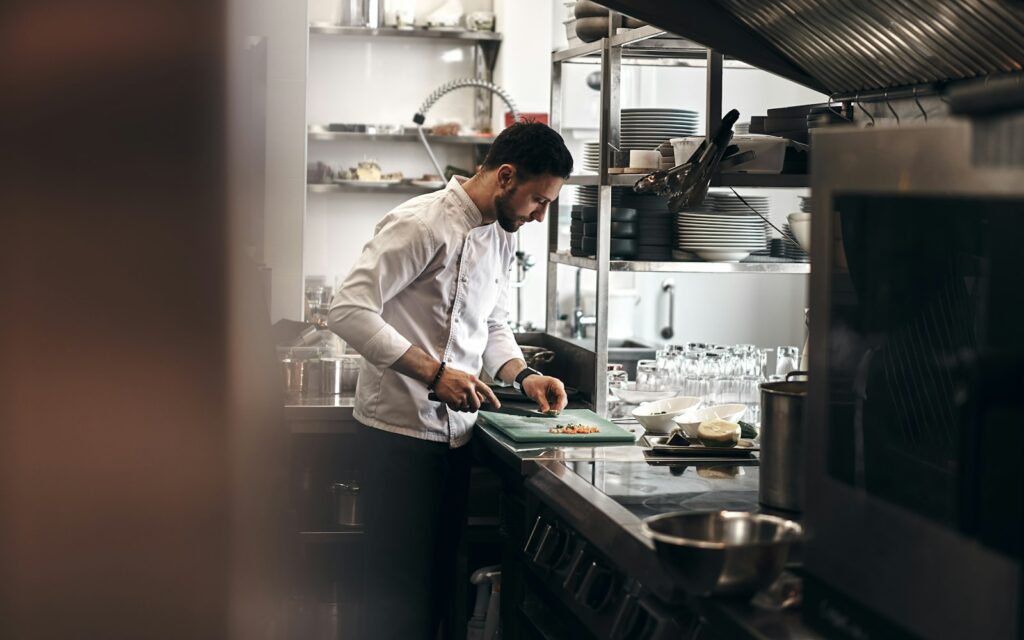
Do you need to speak French to do a culinary internship in France? Not fluently — but the first weeks are much easier if you understand the words that fly across the pass. French kitchens still run on the brigade system and its vocabulary. Here are 60 essential French kitchen words and phrases, grouped the way you will hear them. Save this page on your phone before you fly.
The brigade: who is who
- Chef de cuisine — head chef, runs the kitchen.
- Second (sous-chef) — the head chef’s right hand.
- Chef de partie — in charge of a station.
- Commis — junior cook; most interns start here.
- Saucier — sauces and often meat.
- Poissonnier — fish station.
- Garde-manger — cold station: starters, salads, terrines.
- Entremétier — vegetables, starches, eggs.
- Pâtissier — pastry.
- Plongeur — dishwasher, essential to the whole team.
Service: the words you hear during the rush
- Le passe — the pass, where plates leave the kitchen.
- Bon ! / Ça marche ! — new order coming; “got it”.
- Oui, chef ! — the standard answer: understood.
- Envoyez ! — send it, plates go now.
- Le coup de feu — the rush.
- Chaud devant ! — hot behind/in front, move.
- Attention derrière ! — behind you.
- En place ? — are you ready?
- Table 5 en attente — table 5 is waiting.
- Réclame ! — chasing a plate that is late.
Mise en place and techniques
- Mise en place — everything prepared before service.
- Tailler — to cut; brunoise (tiny dice), julienne (thin strips), ciseler (finely chop herbs or shallots).
- Éplucher — to peel.
- Émincer — to slice thinly.
- Blanchir — to blanch.
- Rissoler / saisir — to brown / to sear.
- Déglacer — to deglaze.
- Réduire — to reduce.
- Monter au beurre — to finish a sauce with butter.
- Napper — to coat with sauce.
- Dresser — to plate.
- Assaisonner / rectifier — to season / adjust seasoning.
Cooking points
- Bleu — very rare.
- Saignant — rare.
- À point — medium.
- Bien cuit — well done.
- Nacré — fish just cooked, pearly.
- Al dente — firm to the bite (yes, French kitchens use it too).
Equipment
- Piano — the stove (literally “piano”).
- Salamandre — overhead grill.
- Four — oven.
- Sauteuse / casserole / poêle — sauté pan / saucepan / frying pan.
- Chinois — conical fine strainer.
- Maryse — spatula.
- Fouet — whisk.
- Bac gastro — gastronorm tray.
- Chambre froide — walk-in fridge.
- Cellule — blast chiller.
Hygiene and organisation
- HACCP — food safety system (same acronym in French).
- Étiqueter — to label (date and content, always).
- DLC — use-by date.
- Filmer — to cover with cling film.
- Nettoyer / dégraisser — to clean / degrease.
- La plonge — dishwashing area.
Phrases that make you look like a pro
- « Je peux goûter ? » — Can I taste?
- « Vous pouvez me montrer ? » — Can you show me?
- « C’est bon comme ça, chef ? » — Is this right, chef?
- « J’ai fini, je fais quoi ? » — I’m done, what next?
- « Il me manque… » — I’m missing…
- « Merci, chef, bonne soirée » — said when you leave, every night.
How to learn them fast
Make flashcards on your phone, label your own kitchen at home for a week, and watch French cooking videos with French subtitles. On site, write new words in a small notebook during breaks — your chef de partie will notice. Language skills improve quickly once you are in the kitchen every day.
Ready to use them in a real French kitchen?
Talents Place helps culinary students from the US, Canada and beyond find internships in French kitchens. Read what to expect in a Michelin-starred restaurant internship, explore our culinary internship program or apply now.